
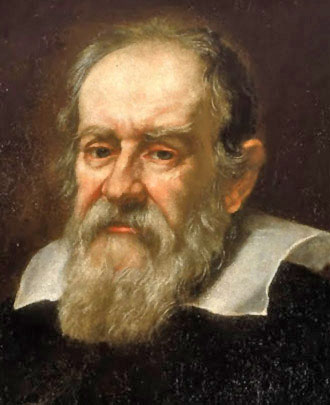
 During his stay in Pisa, which lasted until 1585, Galileo arrived at his first, personal discovery, the isochronism of swings of the pendulum: the paternity of the discovery as assigned to go to Ibn Junis (950 – 1009), it is certain that the ‘activities quell’astronomo Arabic was still completely unknown in Europe.
And so, after four years, the young Galileo resigned to pursue his medical studies and returned to Pisa to Florence, where he furthered his new scientific interests, dealing with mechanics and hydraulics; in 1586 invented an instrument for the determination of the hydrostatic specific weight of bodies: it describes the details in the short treatise bilancetta, first circulated among his acquaintances and published posthumously in 1644. The influence of Archimedes and the teaching of Ricci is also found in his studies on the center of gravity of solids, expressed in theoremata about centrum gravitatis solidorum, published only in 1638 as an appendix to the Discourses and mathematical demonstrations concerning two new sciences, and found a solution to the problem of Hero of the crown.
Meanwhile, Galileo tried a regular budget accommodation: In addition to giving private lessons in mathematics in Florence and Siena, in 1587 he went to Rome to ask for a recommendation to enter the University of Bologna to the famous mathematician Christoph Clavius, [7] but to no avail, because in Bologna they preferred to the chair of mathematics at Padua, Giovanni Antonio Magini. At the invitation of the Florentine Academy in 1588 held two lessons about the shape, size and site of Dante’s Inferno, defending the assumptions already made by Antonio Manetti on the topography of Hell by Dante imagined until, in 1589, recommended by Cardinal Francesco Maria Del Monte, brother of the mathematician Guidobaldo, obtained by the Grand Duke Ferdinando I, a three-year contract to hold the chair of mathematics at the University of Pisa.
During his stay in Pisa, which lasted until 1585, Galileo arrived at his first, personal discovery, the isochronism of swings of the pendulum: the paternity of the discovery as assigned to go to Ibn Junis (950 – 1009), it is certain that the ‘activities quell’astronomo Arabic was still completely unknown in Europe.
And so, after four years, the young Galileo resigned to pursue his medical studies and returned to Pisa to Florence, where he furthered his new scientific interests, dealing with mechanics and hydraulics; in 1586 invented an instrument for the determination of the hydrostatic specific weight of bodies: it describes the details in the short treatise bilancetta, first circulated among his acquaintances and published posthumously in 1644. The influence of Archimedes and the teaching of Ricci is also found in his studies on the center of gravity of solids, expressed in theoremata about centrum gravitatis solidorum, published only in 1638 as an appendix to the Discourses and mathematical demonstrations concerning two new sciences, and found a solution to the problem of Hero of the crown.
Meanwhile, Galileo tried a regular budget accommodation: In addition to giving private lessons in mathematics in Florence and Siena, in 1587 he went to Rome to ask for a recommendation to enter the University of Bologna to the famous mathematician Christoph Clavius, [7] but to no avail, because in Bologna they preferred to the chair of mathematics at Padua, Giovanni Antonio Magini. At the invitation of the Florentine Academy in 1588 held two lessons about the shape, size and site of Dante’s Inferno, defending the assumptions already made by Antonio Manetti on the topography of Hell by Dante imagined until, in 1589, recommended by Cardinal Francesco Maria Del Monte, brother of the mathematician Guidobaldo, obtained by the Grand Duke Ferdinando I, a three-year contract to hold the chair of mathematics at the University of Pisa.
 The result of teaching is the Pisan De motu antiquiora manuscript, which contains a series of lectures in which he tries to give an account of the problem of the movement. The basis of his research is his treatise, published in Turin in 1585, Diversarum speculationum mathematicarum liber Blessed John the Baptist, one of the supporters of the physical theory of ‘"momentum" as a cause of "violent motion." Although not known to define the nature of such a force impressed on the bodies, this theory, developed for the first time in the sixth century John Philoponus and then supported by physicists in Paris, while not being able to solve the problem, opposed to the traditional Aristotle’s explanation of the movement as a product of the same medium in which the bodies move.
In Pisa Galileo did not confine himself to scientific pursuits: in fact date back to this period his Considerations on the rate that will be followed up with Apostilles Ariosto: it is spread on sheets of notes and annotations in the margins of its pages in the volumes of the Jerusalem Orlando Furioso, and where, while reproving the rate, "the lack of imagination and the image and slow the monotony of the verse, what he loves nell’Ariosto is not only a variety of beautiful dreams, the rapid change his situation, the living elasticity of rhythm, but the harmonious balance of this, the coherence of the organic unity – even in the variety – of poetic fantasy. "
In the summer of 1591 the father Vincenzo died, leaving the burden to Galileo to take care of keeping the whole family for the wedding of her sister Virginia, who married the same year, Galileo had to provide dowries, contracting debts, as well as will do for the wedding of her sister Livia in 1601 and will have to spend more money to help the needs of the large family of his brother Michelangelo. Not enough the modest salary of sixty crowns a year, and shortly before the expiry of his contract, Galileo again turned to the influential friend Guidobaldo Del Monte, which recommended him to the prestigious University of Padua, where it was still vacant chair of mathematics after his death in 1588 by Professor Giuseppe Moletti.
September 26, 1592 The authorities of the Republic of Venice issued a decree to appoint, with a contract extension, for four years and with a salary of 180 florins a year. On December 7, held in Padua, Galileo introductory speech and after a few days he began a course designed to have a large following among students. He will remain there for 18 years, which define "better them eighteen years of my age."